Hakka Art Special Exhibition: Song of the Paper Mulberry: Land, People, and Narrative in Hakka Art

Curator / Prof. Shih-Ming Pai, Department of Fine Arts, National Taiwan Normal University
Curatorial Statement /
Curated by Jeffrey Ian Rosen of MISAKO & ROSEN gallery, Tokyo, Turning the Frown Upside-Down focuses on a generation of hybrid commercial / independent exhibition spaces that characterize the very particular commercial landscape that has developed within Japan post 2008.
Land is far more than a physical substrate nurturing life; over the cyclical passage of time, it continually accumulates the generational memories of those who dwell upon it. Amid constant upheaval, migration, and resettlement, land unfolds, bears, and shapes the evolving landscapes and ethnic narratives of successive eras. From primeval wilderness to the dawn of urban civilization, the land has undergone countless iterations of cultivation, exploitation, and transformation. Meanwhile, the perpetual tides of inhabitants have woven a dense and variegated local fabric through their labor, architectural endeavors, and systemic shifts. Yet, while the physical expansion and spatial différance of terrain chart the renewals and strata preserved through spatiotemporal transitions, they cannot arrest the gradual displacement and erasure of past histories, human ethos, and pre-existing realities—leaving them as tenuous textual notes sustained only within the fading lore of succeeding generations.
The renowned Hakka author and critic Li Chiao (b. 1934) has produced an immense literary oeuvre throughout his career, epitomizing the perseverance, diligence, and endurance intrinsic to the ancestral spirit. Many of his acclaimed works stand as enduring classics in Taiwanese literary history. For instance, the Wintry Night Trilogy, completed during the Martial Law era, employs an epic, sweeping prose that not only delineates the lived struggles of individuals and kin, but also reflects the collective predicament of the populace amid dynastic shifts. Imbued with resistance and self-reckoning in the face of adversity, it earned him renown as an enlightened pioneer of transgenerational Taiwanese consciousness. In contrast, his novella That Paper Mulberry Tree—which garnered the Taiwan Literature Award—adopts an allegorical, surreal, and nuanced narrative mode to register a profound sense of helplessness toward the disintegration of traditional values amid rapid socio-economic change.
Driven by a profound humanitarian engagement with the land and the public, Li Chiao repeatedly examines the dialectic between transformation and continuity across shifting spatio-temporal horizons. As he once remarked, “My literature exists solely within an existing Taiwan”—affirming that creative writing is intrinsically bound to the survival and destiny of the land and nation. That Paper Mulberry Tree serves as an underlying manifestation of this civic devotion. "Paper mulberry" (Luzai-shu) is the vernacular Hakka name for Broussonetia papyrifera. Distributed widely across Taiwan and the South Pacific, the tree has long been intertwined with the livelihoods and survival of both Indigenous peoples and immigrant communities, serving as an intimate and enduring symbol of homeland. Narrated through the return of an elderly Hakka farmer to his ancestral village, the novella juxtaposes memory and reality, charting the altered topographical and cultural terrain along the way. Distorted streetscapes and mercantilist transformations manifest as concrete allegories within subsequent dreams; even the paper mulberry tree—once an arbor of sanctuary—cannot escape the fate of withering.
Drawing upon the literary metaphors of Li Chiao’s novella, this exhibition adopts the paper mulberry as a localized spiritual totem signifying the generational survival of the Hakka people. It throws into sharp relief the acute conflicts of interest wrought by urban development, the distorted valuations of land among local inhabitants, and the critical introspection elicited by this existential crisis. Grounded in a narrative model that bridges raw socio-historical realism with rich literary symbolism, the exhibition investigates the intricate and evolving dynamics between land and the populace within Hakka visual art. Featuring four Hakka contemporary artists, the exhibition showcases their diverse material experimentation, stylistic formalisms, visual vocabularies, and layered local specificities across time and space:
Huang Chih-Yang has long investigated the co-constructive dynamics between the classical and the contemporary, the exogenous and the indigenous, with Hakka consciousness emerging as a prominent focus in his recent practice. The representative works featured here harness the monumental volume and gravitas of monumental cliff inscriptions (moya) and sparse-character calligraphy (shaozi shu), channeling the chiseled solemnity of ancient stelae. By intentionally omitting the character Ke (客, "Guest/Hakka") and reassembling Jia (家, "Home/Family") and Ren (人, "People"), the artist interrogates the imperatives of ethnic integration and localized identification. Furthermore, his monumental rendering of the character Mu (母, "Mother") in seal script evokes an intimate, somatic tethering to the motherland through the archetype of maternal kinship.
Chiang Kai-Chun draws his creative impulse from sustained overseas fieldwork in Tahiti, engaging with generational Hakka diasporic lineages and their historical assimilation into Austronesian societies. Under the conceptual umbrella of Global Hakka: Austronesian Chapter, Chiang investigates multi-tiered, fluid states of trans-regional, cross-cultural, and poly-linguistic symbiosis. Utilizing mosaic assemblages—a medium deeply rooted in vernacular folk traditions—the artist allegorizes the continuous, fragmented, and expanding histories of the Hakka diaspora, synthesizing an iconography of totemic motifs to evoke lived actualities of hybridity, resonance, and ethnic harmony.
Chiang Po-Hsuan departs from the strict lineage-based orthodoxies of classical calligraphy, actively channeling inquiries into social relations, feminist consciousness, and territorial identity into her contemporary calligraphic practice. Positioning these themes as interventions into contemporary socio-cultural tensions, she seeks ruptures through established cultural bastions. Beyond liberating orthographic forms and semantic structures into dynamic visual configurations, Chiang reconfigures Taiwan’s toponyms into calligraphic cartographic grids and renders topographies as ink-wash "simulacra," reconstructing personal chronicles woven from travel, displacement, and territorial awareness.
Lu Jyun-Han deploys vibrant palettes and geometric color blocks to compose pictorial tapestries reminiscent of illustrated books, charged with childlike wonder. Through processes of holistic and fragmented deconstruction and reconstitution, his works chronicle serendipitous encounters along his journeys, forming fluid geographical microcosms within a mosaic of memory. Capturing distinct topographies and organic textures—from bustling, packed nocturnal gatherings to serene, expansive expanses of forests, crags, lakes, and seas, down to his contoured, planar relief-sculptures of the Mountain Wandering and Opulent Stone series—Lu weaves allegorical fables suspended between the traveler, the sublime land, and the collective body politic.
HUANG Chih-Yang
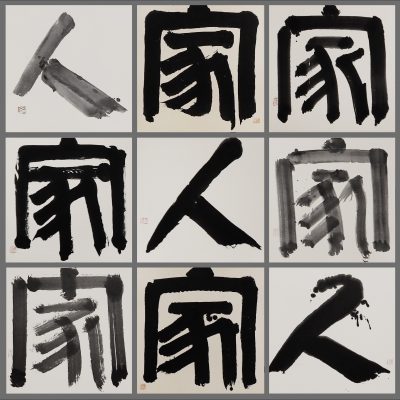
Family | Ink, xuan paper | 270 × 270 cm | 2023
CHIANG Kai-Chun
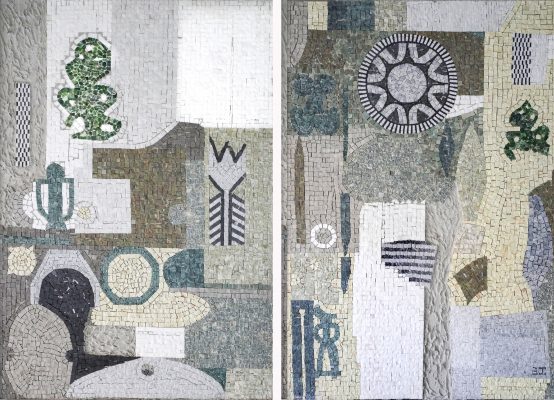
Austronesian Jade Mementos I,II | Nephrite, marble and serpentine | 100 x 70 x 3cm x 2 | 2024
LU Jyun-Han
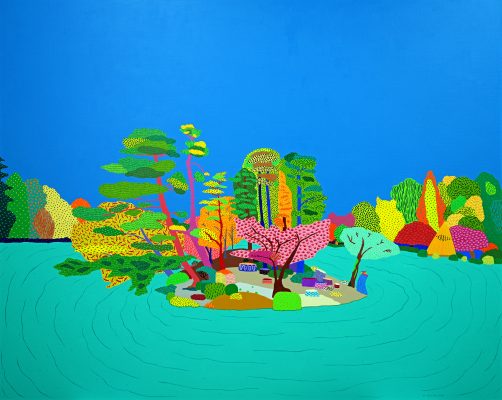
Penglai Island | Mixed media | 130 x 162cm | 2024
CHIANG Po-Hsuan
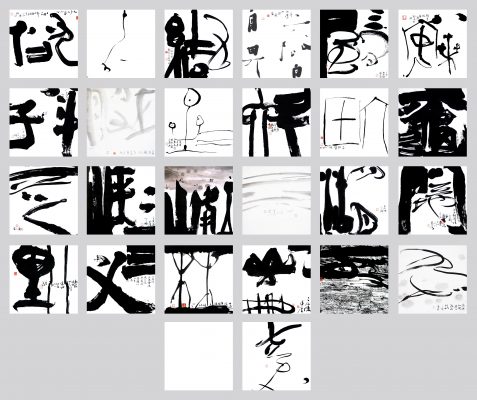
Number Concept_ Taiwan in Numbers | Mounting board, ink, xuan paper | Dimensions variable | 2019