
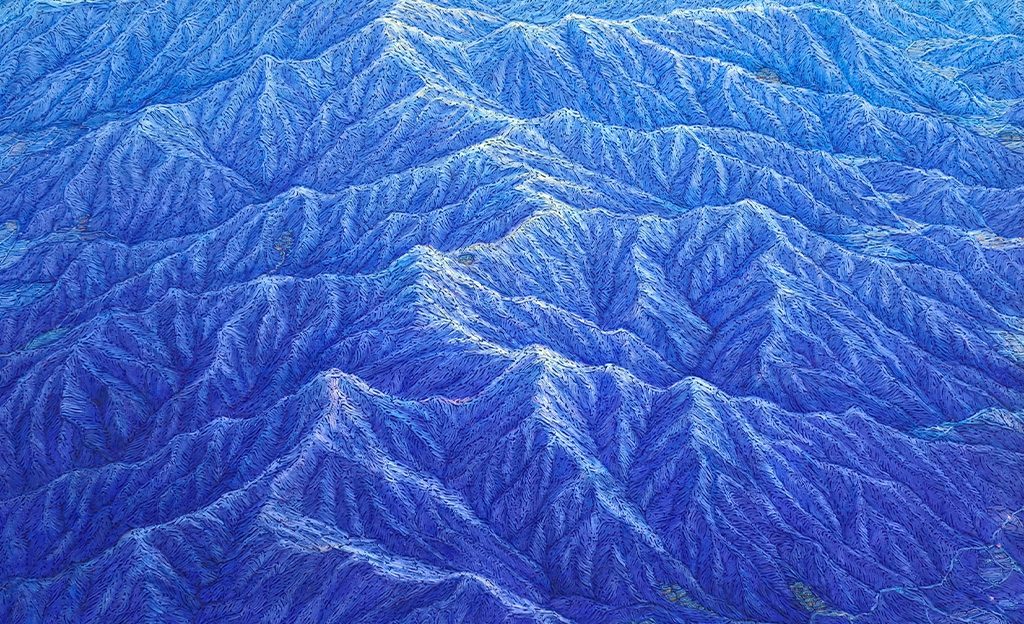
Jeong Won LEE’s recent works draw inspiration from a lifetime of hiking through Korea’s mountains. Through repeated encounters with ridgelines, valleys, rocks, forests, and waterways, she has developed an intimate understanding of the mountain not simply as scenery, but as a living structure shaped by time, ecology, and human presence.
Her current practice focuses on the Baekdudaegan, the great mountain spine of the Korean Peninsula. Viewed from an elevated perspective, its vast network of peaks and ridges unfolds like a living skeleton. Each mountain possesses a distinct form, yet when seen together, the repeated rhythms of their contours reveal an underlying natural order. Following the principle that mountain ridges divide watersheds, countless streams branch outward, while diverse ecosystems and human lives take root in the spaces between them.
LEE reconstructs these landscapes using shredded paper. Unlike the fluidity and tonal subtlety of brushwork, paper has a coarse, resistant materiality. Yet its rough texture and physical volume allow her to evoke the tactile presence of rocks, trees, and mountain ridges with remarkable immediacy. The direction in which each fragment is attached generates movement across the surface, while changes in the viewer’s position can produce shifting optical effects.
For LEE, however, the repeated act of making has become more important than the representation of the mountain itself. Cutting and attaching countless fragments of paper, spraying color, and applying successive brushstrokes form a slow and meditative process. Just as innumerable elements come together to create a single rock or ridge, thousands of fragments and repeated gestures gradually bring the artist closer to the mountain. This labor is grounded in years of hiking, observation, and drawing, and becomes a form of physical and spiritual encounter with nature.
Her work is connected to the spirit of Jingyeong Sansu, or true-view landscape painting—not as a literal depiction of a particular place, but as an attempt to reveal the principles and inner order through which landscape is formed. Mountains do not easily disclose their true nature. Through a continual process of “searching within the mountains,” LEE approaches painting not merely as the production of a finished image, but as an act of discovery in which the meaning resides in the process itself.