SUNJAE GALLERY
B26 / Cheonan-si / Korea
+82-10-9654-7102
sara0530@naver.com
https://sunjaegallery.creatorlink.net/

+82-10-9654-7102
sara0530@naver.com
https://sunjaegallery.creatorlink.net/
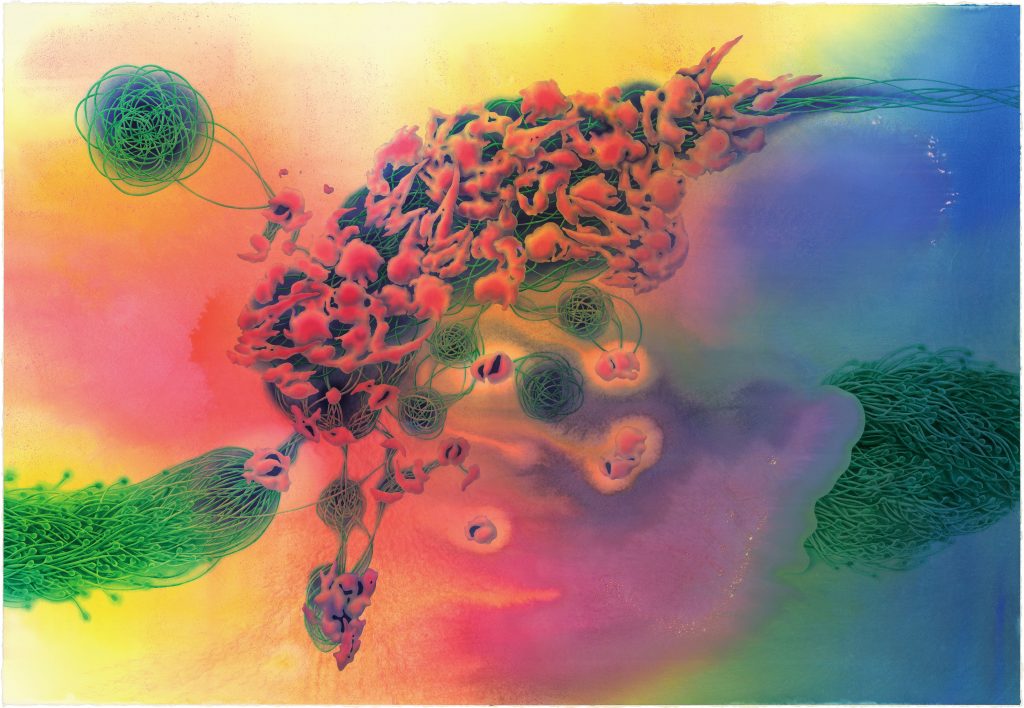
Jonghoon IM’s artistic practice begins with research into the symbolic systems of animals and plants found in myths and folk beliefs across different cultures, as well as investigations into ecological phenomena. These explorations stimulate the artist’s imagination, generating new associative images and creating opportunities for subjects of different origins and heterogeneous metaphors to dissolve their boundaries and merge with one another.
Just as Hermaphroditus, the deity in Greek mythology embodying both male and female characteristics, symbolizes fertility and harmony, the fusion of heterogeneous elements ultimately transforms forms into hybrid images, expanding their visual language. These hybrid forms are realized through painting, sculpture, installation, and animation.
Transformation of Form
Occupying much of the pictorial space and primarily rendered in green, the teardrop-shaped spikes in IM’s paintings are forms that emerge through poetic associations between opposing concepts such as desire and self-restraint, prohibition and transgression.
Originally, the thistle, a plant that protects itself from the outside world with sharp thorns, symbolizes discipline and self-restraint. However, the artist imagines the thistle gradually transforming into the opposite of its original appearance after experiencing the longing of Eros. IM visually interprets this erotic transformation: rather than clinging to itself, the thistle loses its original form and regains vitality alongside another being. Its sharp thorns gradually become rounded and dull, undergoing a process in which they lose their defensive function.
Paradoxically, it is precisely at the moment when they completely lose their ability to defend themselves that the spikes begin to writhe as if driven by an intense longing, extending in every direction and acquiring vivid, organic movement.
Resembling blood vessels or electrical cables, these teardrop-shaped spikes function as connectors linking various forms throughout IM’s paintings. These “various forms” constitute a pictorial language developed through the artist’s exploration of the broad concept of hybridity.
In the mind map that IM created with Eros as its starting point, the words “desire” and “longing” appear together, followed by “fusion” and ultimately “hybrid.”
Hermaphroditus, the deity embodying both male and female identities in Greek mythology, inspired IM to imagine forms in which male and female reproductive organs merge. From this point, his imagination expands beyond the binary of male and female, breaking the boundaries between human and machine, organism and inorganic matter to produce hybrid imagery.
Consequently, traces of both male and female reproductive organs coexist within his works alongside smooth, mechanical surfaces, vivid artificial color combinations, soft curves, and hard textures. Forms gradually become abstract while acquiring a complex visual language.
Each form exists as a segmented unit, allowing it to be dismantled and recombined with other elements at any moment. Through continuous processes of assembly and variation, IM develops an ongoing series of interconnected works. Rather than pursuing fixed forms, he is interested in states capable of continual transformation and the formation of new relationships.
The possibility of variation stimulates the very nature of desire. Once one variation concludes, another immediately becomes desirable, reflecting the perpetual movement of desire itself. This continuous movement is fundamentally linked to the concept of hybridity. IM is deeply fascinated by forms that reject permanence and remain flexible enough to merge with other elements at any time.
The Process of Painting: The Interplay and Circulation of Chaos and Cosmos
IM’s handling of materials likewise involves the interaction of contrasting methods. He primarily works with acrylic ink on paper. The process begins by thoroughly soaking large sheets of paper with water before allowing various colors of ink to flow freely and uncontrollably across the surface.
As the ink spreads through the wet paper, it is influenced by countless material factors—including the weight of the pigments, surrounding humidity, and even the subtle inclination of the studio floor—causing forms to emerge in unpredictable ways.
Here, IM associates this process with Chaos, the primordial state of disorder. Just as Chaos signifies both disorder and the latent potential for new order, these irregular and spontaneous ink flows gradually become the foundation for the overall composition and placement of motifs.
Once the paper has completely dried, the artist employs masking tape and stencil techniques to carefully position forms over the traces left by the ink. In other words, he reorganizes the image through an extremely deliberate and controlled process.
The work, however, does not end there. IM subsequently rubs or scrapes away portions of the nearly completed image using rough tools, or wets the surface once again before boldly pouring additional ink over it, initiating a process of deconstruction.
Through this reversible creative process, parts of the original image become unrecognizable while entirely new forms emerge within the areas of deconstruction. The artist repeatedly makes subtle adjustments, deciding which details to emphasize and which areas to preserve as empty space.
As construction and deconstruction, planning and intuition accumulate upon the surface, the painting becomes a space composed of multiple layers. IM continues adjusting the relationship between these opposing forces until he senses that no single element dominates another, but instead reaches a state of dynamic equilibrium. Only then does he put down his brush.
As the artist himself explains, this is “not the pursuit of pure rationality, but the result of an intense collision between heterogeneous elements such as planning and impulse, calculation and intuition.”
Bronze Sculpture: The Fluidity of Wax and the Fixity of Metal
Like his paintings, IM’s sculptures do not begin with fully predetermined designs. Instead, they originate from experiments exploring how the inherent properties of materials can generate unexpected variables.
The *Teardrop Spike* series particularly demonstrates how carefully planned formal control coexists with the spontaneous behavior of materials responding to gravity and temperature.
The artist is especially interested in the transformable nature of wax. Wax melts into liquid when heated and solidifies again as it cools. IM first creates clusters of spikes from fully hardened wax before immersing them into melted liquid wax and lifting them out again.
The molten wax flows downward along the existing structure before gradually solidifying upon contact with cooler air. Under the influence of gravity, the hardened wax accumulates into droplet-like or soft organic forms. What begins as a hand-shaped structure simultaneously becomes a natural form determined by the autonomous movement of flowing wax.
These completed wax models are subsequently cast in bronze, transforming into rigid metal structures. The fleeting moment of fluid movement becomes permanently fixed within solid metal.
Finally, IM chemically patinates the bronze surface. As green oxidation gradually develops over time, the artificial metal sculpture begins to resemble living plant stems or moss, blurring the distinction between manufactured object and natural organism.
Ultimately, the *Teardrop Spike* series brings together opposing qualities—liquid and solid, gravitational flow and rigid permanence—within a single sculptural form.
Expansion of Medium: From the Fixed Surface to Sequence
The movement of desire also gives rise to changes in dimension. IM’s animation *Tale of Tales* transfers hybrid forms from the fixed two-dimensional surface into digital space, transforming them into moving images in an effort to transcend static existence and acquire temporality.
The cave imagery appearing at both the beginning and end of *Tale of Tales* is based on photographs the artist personally took while visiting the vast Postojna Cave in Slovenia.
The stalactites, formed over millions of years through natural geological processes, provided profound formal inspiration. The opening sequence, in which a massive stalactite splits apart like a doorway before drawing the viewer deep inside, not only visualizes the origin of the artist’s sculptural imagination but also represents the threshold leading into the virtual space that unfolds thereafter.
The paintings, originally completed on paper, are scanned in high resolution and placed upon a digital timeline. Individual images, once existing as independent finished works, are animated and organically connected to one another, becoming sequences that compose the animation.
For example, after a life form from one painting disintegrates and scatters, a pink sphere appears, from which tiny organic forms begin to emerge and writhe. As they proliferate outward infinitely, they gradually regenerate into more fully developed organisms than before. This vividly demonstrates how separate painting series merge within digital space and evolve into entirely new images.
Toward the conclusion of the animation, the camera returns once more to the cave's stalactites before revealing another newly formed stalactite. This cyclical structure not only recalls the original source of the artist’s formal inspiration but also suggests that his pictorial world continually expands beyond digital space, developing into another organic narrative.