GSA Gallery
A19 / Taichung / Taiwan
+886-4-2471-9955
+886-9-0944-8158
greatsealart@gmail.com
https://www.gsagallery.com

+886-4-2471-9955
+886-9-0944-8158
greatsealart@gmail.com
https://www.gsagallery.com
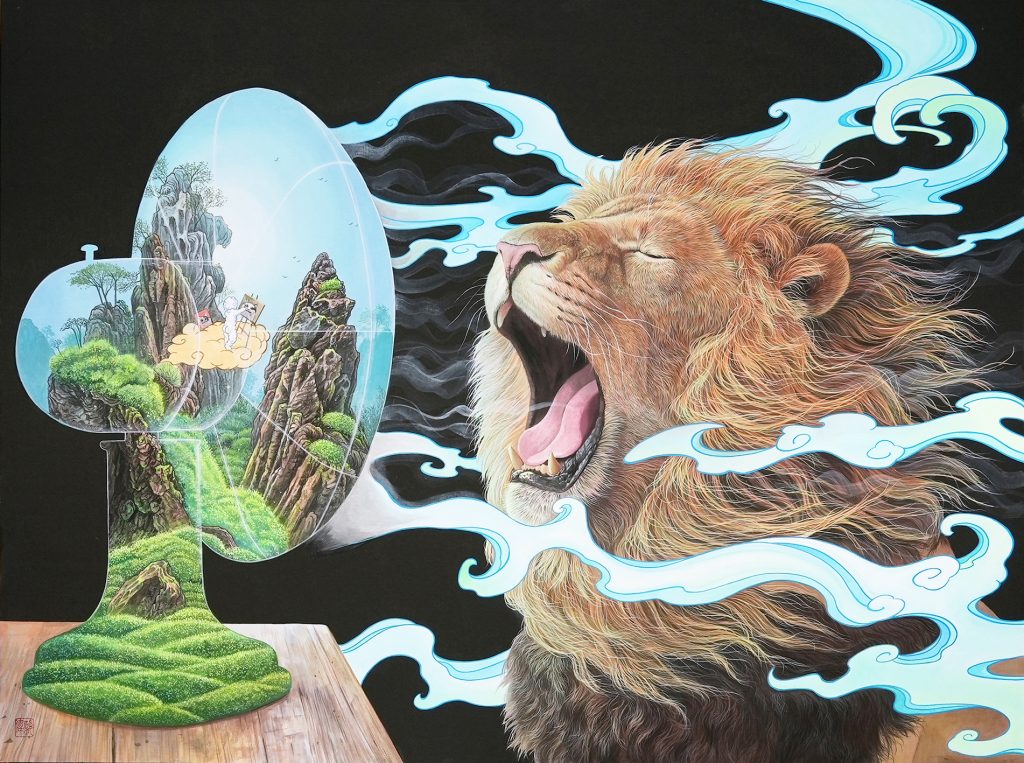
Echo continues Li Jun Wei’s “Aquarium” series, an ongoing exploration of the relationship between one’s inner world and external reality. Through a surreal visual language, the work examines how individuals perceive, interpret, and respond to the countless voices and stimuli surrounding them. The aquarium is transformed into the shape of an electric fan, while a roaring lion stands outside it. Rather than entering unchanged, the lion’s roar is distorted, delayed, and reshaped—much like the amusing, altered sound produced when speaking into a fan during childhood. This familiar experience becomes a metaphor for human perception: we never receive the world exactly as it is; instead, every experience is filtered through memory, emotion, and lived experience before it takes on meaning.
Inside the aquarium, the cloud-like figure remains calm, quietly painting the lion beyond the glass. Creation thus becomes a way of responding to reality—not through confrontation, but through transformation; not by escaping the world, but by understanding it. Li converts anxiety, pressure, and the noise of contemporary life into poetic imagery infused with lightness and subtle humor. What initially feels overwhelming gradually becomes something that can be observed, contemplated, and even appreciated.
From the perspectives of psychology and phenomenology, Echo suggests that what truly shapes us is not the event itself, but the meaning we assign to it. Each person carries an invisible “aquarium” within—a private space where memories, beliefs, and emotions are preserved, determining how the outside world is ultimately perceived. In a life saturated with constant information, expectations, and emotional demands, we may not be able to silence the noise around us, but we can choose how we listen and respond.
Ultimately, Echo is not merely about the return of sound, but about the transformation of consciousness. It invites viewers to reflect on whether they can maintain a sense of quiet resilience amid the pressures of daily life, relationships, and an ever-changing world. By transforming every echo of experience into nourishment for the inner self, Li reminds us that art is more than a reflection of reality—it is a mirror through which we come to understand ourselves and gently reconcile with the world around us.