
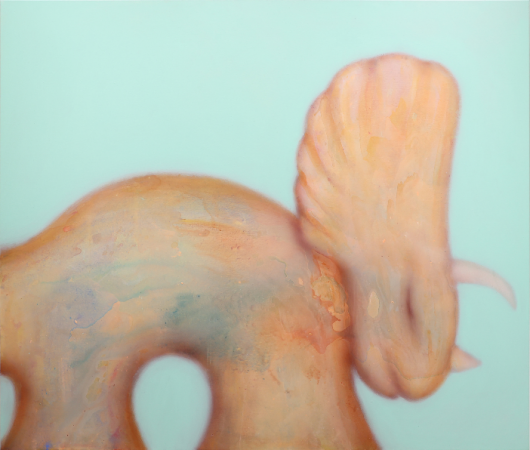
Felix Treadwell has long been fascinated by the reproduction and transformation of dinosaurs as cultural symbols. Through his practice, he reintroduces onto the canvas outdated, inaccurate, and at times absurd scientific illustrations and representations from earlier periods of human history.
In the early 20th century, the Tyrannosaurus rex skeleton first exhibited at the American Museum of Natural History was presented with an upright posture and its tail resting on the ground, rather than the horizontally extended, elevated tail position suggested by contemporary research. This “corrected error” was subsequently reproduced through the visual languages of stop-motion animation, popular science illustrations, children’s books, and plastic models, shaping an entire generation’s fundamental image and intuitive understanding of the T. rex. In doing so, these misconceptions gave rise to an aesthetic system of their own.
Although such images have since been challenged and revised by modern science, they continue to carry a powerful emotional and cultural force, becoming embedded within our collective memory. Rather than attempting to correct these historical inaccuracies, Treadwell chooses to embrace and preserve them. His approach becomes both an act of restoring deeply rooted memories and an exploration of humanity’s enduring fascination with vanished worlds, as well as our desire to project emotions onto that which remains mysterious and unknown.
Through painting, Treadwell transforms “error” into a starting point for aesthetic and intellectual inquiry. By working with the visual remnants of inaccuracies, ambiguity, and uncertainty, he proposes a fundamental shift in artistic perspective: how can contemporary art transform erroneous images of knowledge into vessels of cultural memory, while creating a visual language through which our generation can reclaim its own interpretation of the past?